



When I first opened a brokerage account, I had no idea what I was doing.
I was buying penny stocks. Chasing biotech’s my uncles were talking about. And I had exactly zero plan for when to get out. Not for when things went well, not for when things went badly. It never even occurred to me that getting out was a decision you were supposed to make on purpose.
I don’t think I was unusual. I think that’s where most people are.
Most people buy a stock and that’s the end of the thinking. They’re going to hold it. There’s no exit plan in either direction. And I’ve come to believe that this one blind spot is why people get so wrapped up in narratives. The bubble talk. The “this can’t last.” The bear thesis they cling to. When you believe your position is permanent, you have to be right about the whole future. That’s an impossible amount of weight to carry on a single stock.
It’s not permanent. There are rules for getting out. I use three of them…
Rule 1: Cut the loss from your entry
This is the first skill you should build. Before pattern recognition, before anything. If you learn nothing else, learn this.
Here’s how I actually do it.
O’Neil famously preached an 8% stop. But he never really connected it to how big your position was, and that’s the part that matters. A stop only means something in the context of your total account.
The rule most serious traders and fund managers live by is this: never risk more than 1% of your total equity on a single trade. Not 1% of the position. 1% of everything you’ve got.
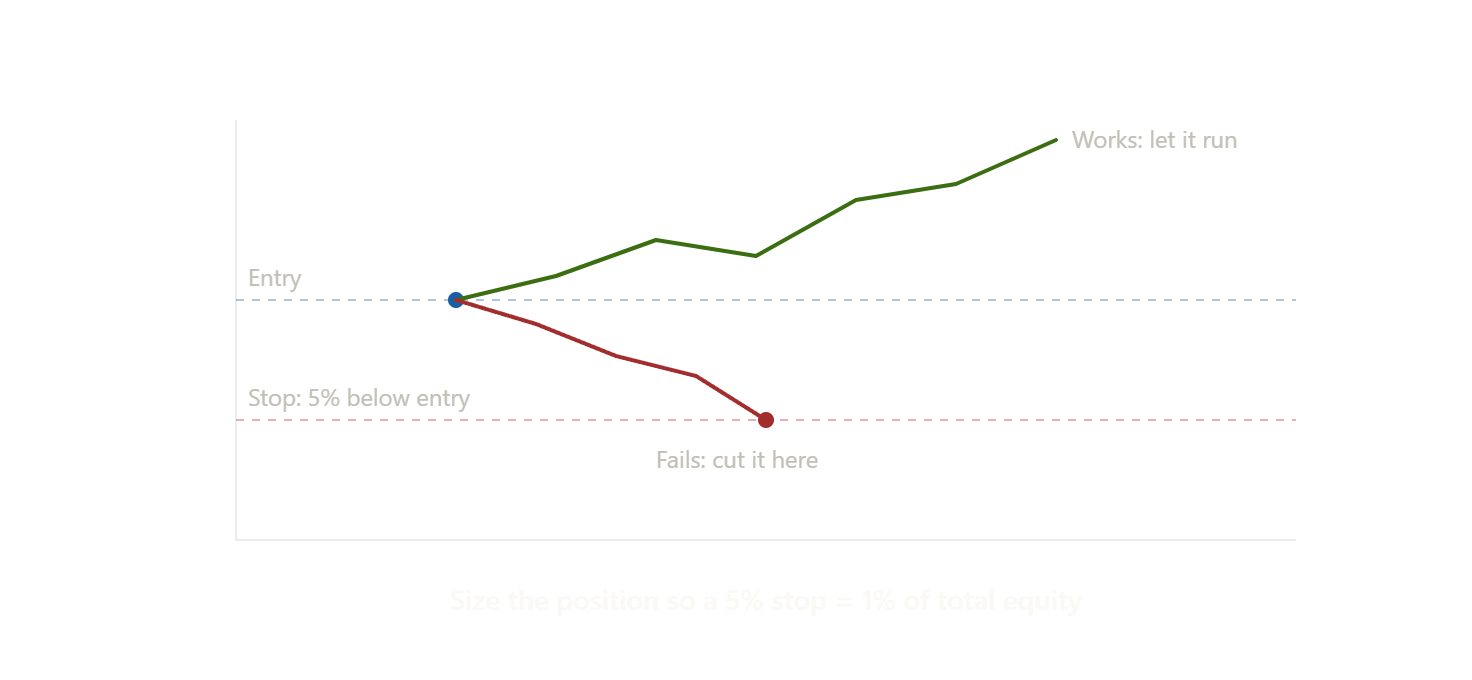
So I work backwards from that. My standard position is 20% of my account in one stock. If I put 20% into a name and it drops 5%, that’s a 1% hit to my total equity. So my stop goes at 5% below my entry.
That’s the whole system in one line: size your position so that your stop equals a max of 1% loss to your total account.
Keep your stops somewhere between 5% and 8% from your entry. Eight is the absolute ceiling, never more. I personally live in the 5 to 7% range. Run your own math on your own position sizes and find the spot where a stop-out only costs you about 1% of the account.
The other place I’ll set a stop is the low of the day on the day I bought. If I entered on a breakout or an upside reversal, that day’s low is a line that matters. Break it and the reason I bought is gone.
This rule alone will do more for you than any indicator you’ll ever learn. It’s boring, but it’s the closest thing to a superpower I’ve found in this business.
Rule 2: Take some profits into strength
The first rule keeps you alive. This one is the first rule that actually makes you money on purpose.
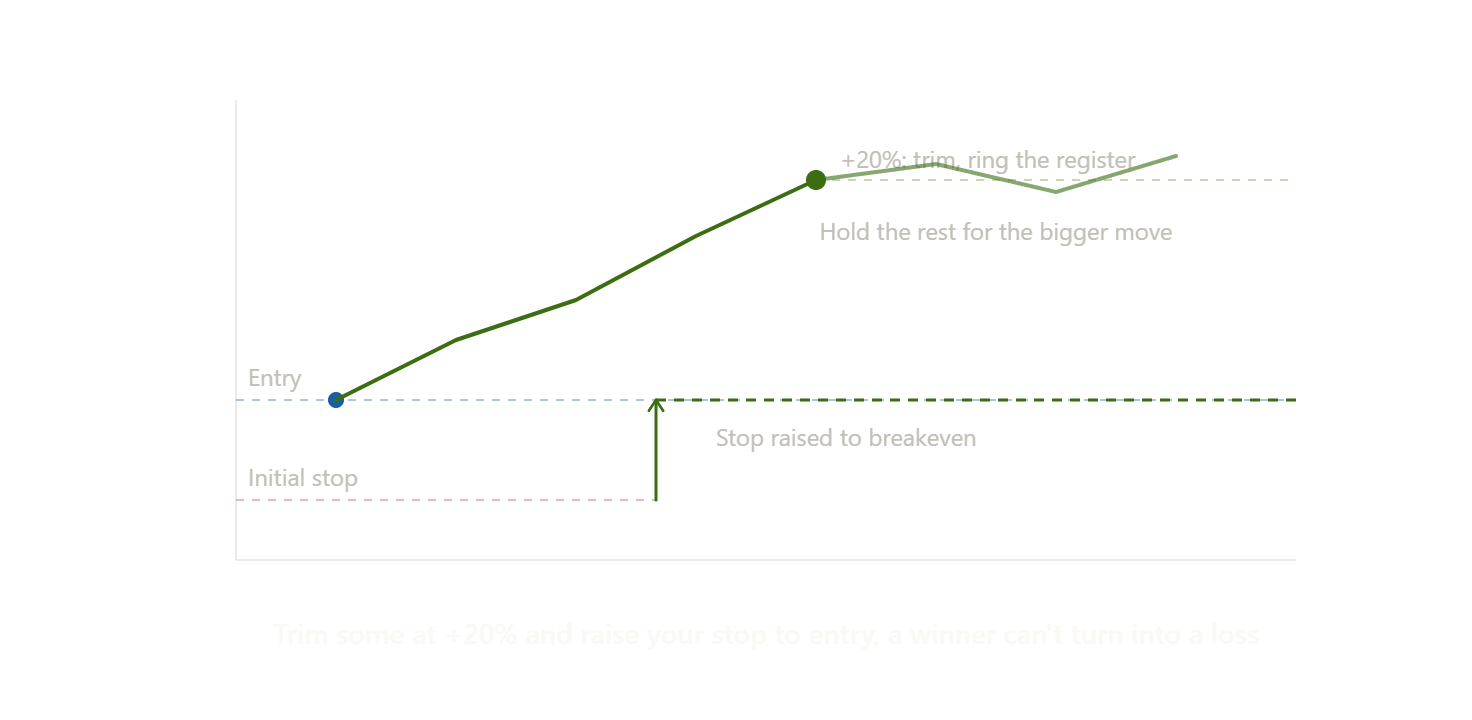
Say you cut losses at 5% and you take three losses in a row. Then you sell one winner into strength at a 20% gain. You were only right one time out of four, and you still came out ahead. You don’t need a high batting average. You need your winners to be bigger than your losers, and you need the discipline to actually ring the register.
Now, how much you sell depends on your time horizon. I tend to hold for the bigger move, somewhere between three months and a year, so I’m not dumping my whole position at a 20% pop. But I am trimming.
Here’s why trimming matters even when the amount feels small. Say you had a 20% position and the stock runs. Now it’s grown to 22 or 23% of your account just from the gain. If I trim it back to my original 20%, I’ve locked in real profit and gotten the stock back to the weight I wanted. Small transaction but a big psychological effect. It gets you in the habit of realizing gains instead of just watching them on a screen.
There’s a companion move that lives inside this rule, and I want you to treat it as automatic: once a stock works and moves up, raise your stop to your entry price. Breakeven. The moment your trade proves itself, you take the possibility of a loss off the table.
Do those two things together, trim into strength and move your stop to breakeven, and something powerful happens. Even if the stock round-trips all the way back down, you made money. You rang the register on the way up, and you got stopped out at breakeven on the rest. You cannot lose on that trade anymore.
That’s not just protecting your capital. It’s protecting your confidence. You lose faith in yourself fast when you keep watching gains evaporate back to zero. Protecting your mental capital is every bit as important as protecting the dollars.
Rule 3: Use moving averages as your trailing stop
This is how I sell most of my winners.
Say everything went right. The first two rules never had to fully trigger because the trade worked from the jump. You moved your stop to breakeven, you trimmed some into strength, and the stock kept going. Now you’re holding for the big move.
When I study a chart, one of the very first things I look for is which moving average the stock respects. Where has it found support before? That’s the line I’ll use to trail my stop, because that’s the line that tells me when the character of the stock has actually changed.
O’Neil talks about the 50-day as the ultimate line in the sand, and I completely agree with it. I don’t own stocks under their 50-day. Period.
But the 50-day is sometimes a long way down from where a stock is trading, and I want to move a little quicker than that on the way out. So I use two lines:
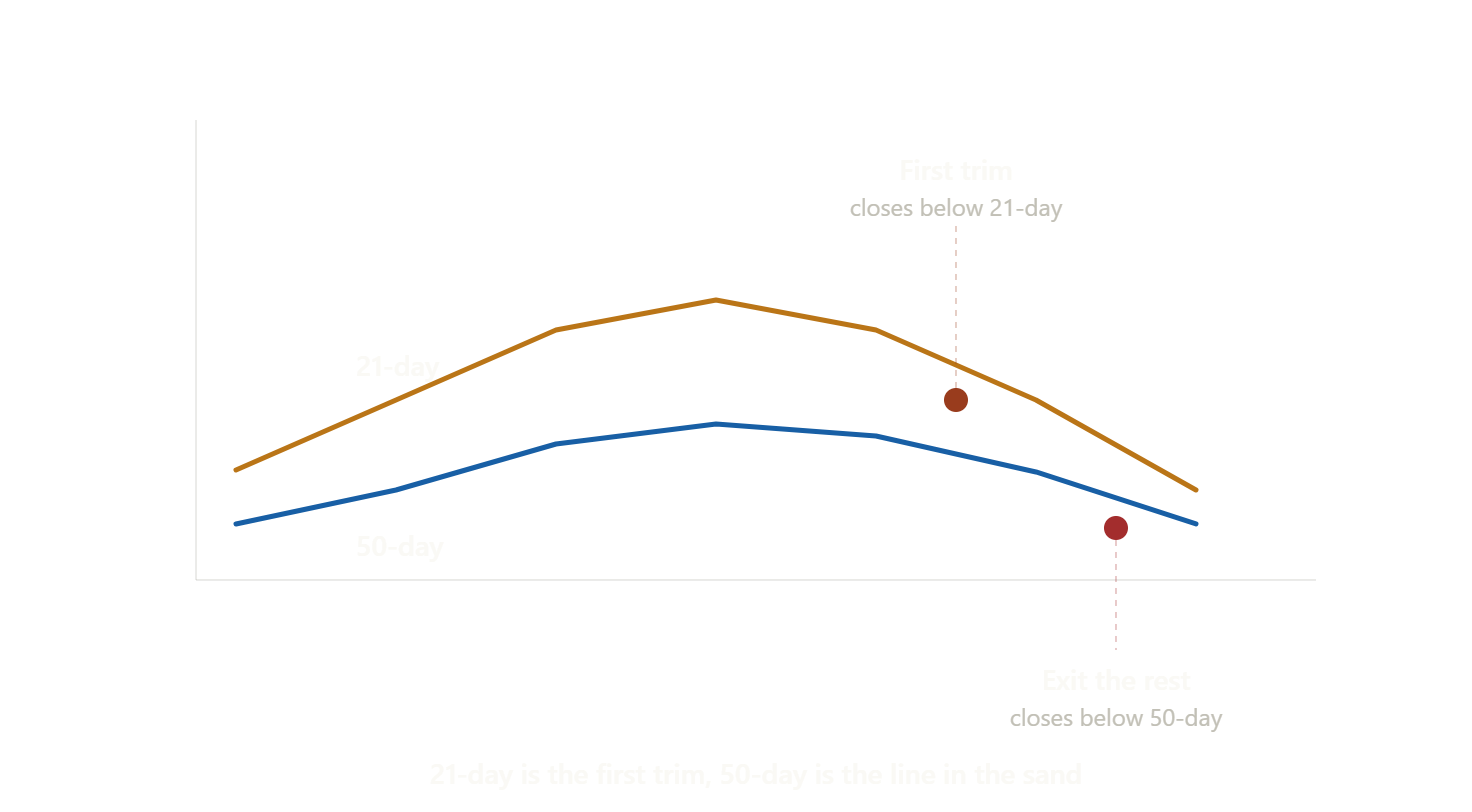
The 21-day is my first trim trigger. A stock can dip below the 21-day intraday, that’s fine. But when it closes below the 21-day and then can’t reclaim it, that’s a change in behavior. That’s where I’ll start scaling down.
The 50-day is the line in the sand. A decisive close below the 50-day and I’m out of what’s left. No debate.
So it becomes a way to scale out in stages. Say a position has grown to a 30% max size because I’ve let a winner run. If it breaks the 21-day, I might take it down to 20%, back to where I started. If it then breaks the 50-day, that’s when I exit the rest completely.
One exception: The 200-day is only relevant for a true long-term holding. A stock you’ve owned for years, a genuine market leader, something you’re holding for a move that takes a long time to play out. Even then, a close below the 200-day is blasphemy. I’ve never found a good reason to sit through it.
Bringing it together
Those are the three. The three that have kept me from blowing up in over a decade of doing this.
Cut your losses fast from your entry, and don’t be shy about it. The best trades usually work right away. If you trade long enough to string a couple winners together, you’ll feel this in your bones. You don’t need to give every stock extra room and extra time and extra chances. There’s always another opportunity coming.
It’s okay to have high expectations for where you put your money. The market should work for your money, not the other way around. So get comfortable with this: it didn’t work right away, you’re fired. Never get married to a stock.
The most important thing underneath all three is just this: have a plan before you’re in the trade. Know where you get out on the downside and know what you’ll do on the upside, and decide both of those things before you click buy.
That’s how I stay in the game.
Solid advice! Thank you.