


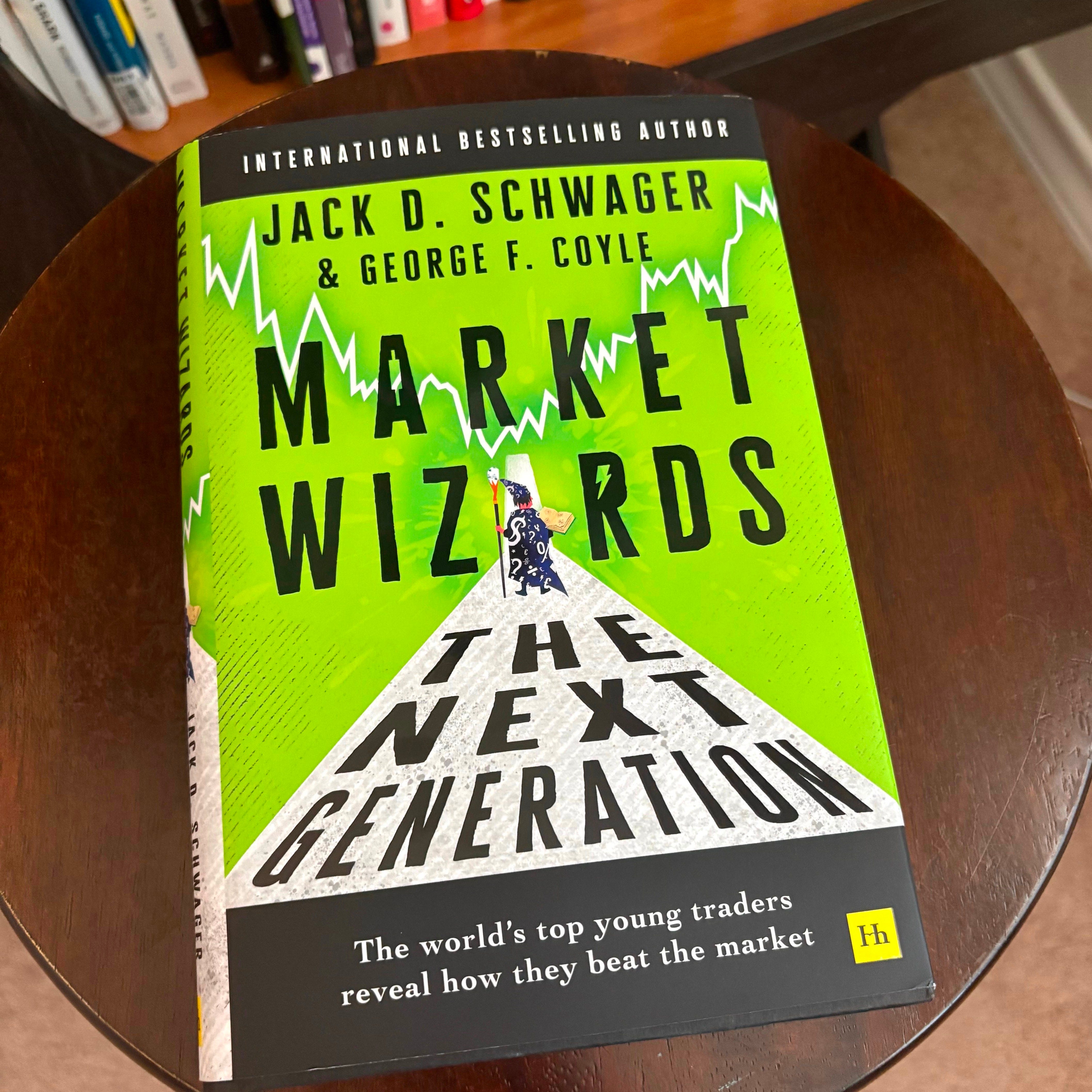
Reading wasn’t really my thing before I started trading. Outside of books about sports, non-fiction didn’t interest me much.
Then I got into the business, and I figured out pretty fast that reading is basically the second job. The first thing you do is trade. The second thing you do, if you’re serious, is read about trading. Everybody at the firm talked about books like they were scripture.
So I read them. How To Make Money in Stocks. Reminiscences of a Stock Operator. The classics.
But the one everybody pointed to, the one that came up in every conversation, was Market Wizards.
Here’s my confession about the original Market Wizards: I didn’t know how to read it.
Every chapter was a different trader running a completely different strategy. One guy swears by one thing, the next guy does the opposite and also made a fortune. As a beginner that was confusing to me. I kept trying to find THE answer and the book refused to give me one.
It took years before I understood the assignment. You’re not supposed to copy any single one of them. You’re supposed to pull nuggets. Take the best of what each person figured out and see which pieces fit you. The book only made sense once I had enough screen time to recognize myself in the war stories.
So when Jack Schwager and George Coyle put out Market Wizards: The Next Generation, I pre-ordered immediately.
This one is different for me, and the reason is simple. These are my guys.
The traders in this edition are my generation. Same age, same markets, same war stories. They have battle scars from the same years I do. When they talk about getting humbled, they’re talking about the exact tape I was trading. That hits differently than reading about a legend from the 1980s.
The chapter that stopped me cold was the first one, Kristjan Kullamagi. The way I see him, he’s the next thread coming off William O’Neil and Dan Zanger. Growth, breakouts, momentum. Same DNA, new generation. That’s a chapter I’ll reread over and over again.
I took notes the whole way through. Five things kept showing up, across different traders running different systems. Those are the five worth your time.
1. Cut your losses quickly. And then cut them quicker than that.
You’ve heard this a thousand times. I’ve heard it a thousand times. It’s the first skill you build and the most important one you’ll ever have, and it’s still the rule most people can’t actually follow.
So the takeaway for me wasn’t the rule itself. It was how violently aggressive these traders are about it.
A few of them won’t even wait for a stop. If the trade isn’t working right away, they’re out. Not down 8%. Just not working. Gone.
Peter Brandt, in an earlier edition, talked about closing any losing trade before the weekend, and that one made it straight into my core rules years ago. But this generation takes it further. Some of them want the trade to pay immediately or they walk.
There’s something almost snobby about it, and I mean that as a compliment. You’re treating gains like an entitlement. You bought strength, so the strength better show up now. If it doesn’t, the trade already told you the answer. You’re playing defense first and you’re only willing to hold the names that prove themselves on day one.
2. Gamers make kickass traders.
This one’s my favorite, and it’s a little funny.
A bunch of the wizards in this edition play video games. And more than one of them draws a direct line between gaming and trading. The hand-eye speed. The competitiveness. The pattern recognition under pressure.
I grew up on this. PvP gaming, Xbox Live, that specific wiring where you’re reading an opponent in real time and reacting faster than you can consciously think. I always quietly saw the market as a video game. Same feedback loops, same instinct layer built on top of thousands of reps.
To hear some of the best to ever do it make the exact same connection was validating in a way I didn’t expect. Turns out the thing I thought was a distraction growing up was training.
3. Bad sizing is what actually kills you.
This is the one I needed to read, because position sizing has been my Achilles heel.
When I was at O’Neil, everyone wanted to be like Bill. I remember his son Scott coming out to the floor and telling us the firm was something like 200% long Tesla at one point. Aggressive beyond anything I’d heard. It made a permanent impression. I walked away thinking that’s how you make real money. Get the leader right, then press it hard.
And it worked. I’ve had triple-digit years sizing like that.
But here’s what this book made me sit with. The traders who last are obsessed with size, and a lot of them size down, not up. Some adjust position size based on the quality of the setup. The recurring theme is that getting big is the easy part. Holding the position through a drawdown from the top, without getting shaken out, is what separates the pros.
When you run the math honestly, a 25 to 30% position I can actually hold through the noise beats a 100%+ position that throws me out at the first scary day. Time and compounding do more work than leverage, and they let me stay in for the bigger move. The size that lets you sleep is the size that lets you hold.
4. You can’t impose your will on the market.
One of the wizards said this and it’s been rattling around my head since.
This is patience, really. The discipline to sit and wait for your best setup instead of forcing action. Kullamagi talks about how much he struggles with this, because he loves to trade and sometimes overtrades just to be in the action. That’s me. The hardest thing some days is not trading.
His fix is brilliant in its self-awareness. When he knows a setup isn’t his best, he sizes it small, because he knows he can’t fully stop himself from taking it. So he manages the trader instead of pretending the trader is someone he’s not.
Simon Russo framed the same idea a different way: be reactive, not predictive. Don’t force your opinion into the trade. React to what the market is actually doing. That might be the single healthiest way to hold the market in your head.
5. Focus on your process. Then have the discipline to follow it.
Across the whole book, the wizards are process-driven, not outcome-driven. They’re constantly innovating, reshaping their rules to fit changing markets and their own growth as traders.
But here’s the part that’s easy to miss. They follow the rules.
You hear it again and again. They have rules, they break them, they pay for it, they write new rules. Bill was the king of this. Watch his interviews and it’s just rules, rules, rules. Nobody wants to hear that. It’s not the fun part. The fun part is the setup and the run when you’re green.
The boring part is watching a trade you don’t own run without you because it didn’t meet your criteria. Sitting out a tape that doesn’t fit your conditions. That discipline is wildly underrated and brutally hard, because the market is a moving psychological target that never stops testing you.
Which brings me to the thing that actually changed my trading this year.
I physically write my rules down now. My own rules.
Most people start the way I started, by adopting someone else’s rule set wholesale. I bought How To Make Money in Stocks and decided that was my system, word for word. And that’s a fine place to start. But you don’t see real improvement until you stop borrowing rules and start molding them to fit you. Your tendencies. Your weaknesses. The specific ways you trip yourself up.
This book is full of traders who figured that out. That’s the meta-lesson hiding inside all five takeaways.
Final word.
This might be my favorite book in the series. Not because it’s better written than the originals, but because these are my people. We came up on the same stuff. We carry scars from the same years. 2022 was the year I mentally blew up. I didn’t lose the whole account, but I took a huge drawdown and something broke in my head that took a long time to rebuild. Reading other people describe their worst drawdowns, and what they pulled out of them, is the kind of thing that makes a trading book worth more than its setups.
Read the whole thing. But if you only read one chapter, read the first one. Kullamagi. There’s a generation of wisdom packed into it.
I have it on audio too. I’ll be going back through it more than once.
I write Ghost Alpha to document one trader’s real journey, scars included. If you want the trades, the rules, and the lessons in real time, subscribe and come along.
Good stuff! I’m not a trader, but I do like integrating technical analysis with fundamentals. About 2022, you should check out managed futures! They rocked in 2022 and are doing good in 2026. Lots of them are based on trend following.
Good review, thank you!