


Every bear market starts the same way for me: choppy.
2022 started that way. This year started that way.
I’ve had moments in my career when I was guessing the bottom of the market, only to be chopped up some more.
This is the system I use to fix that.
Why you need a system
When the trend keeps changing, you need rules for when you are in the market at all.
This is for going from cash, in a defensive downtrend, to a market starting a new uptrend.
We use the QQQ to mark where to start scaling into individual stocks. The general market is the most important piece of when we get involved in growth stocks, so we want the index in our favor first.
I learned this from Mike Webster. He was one of William O’Neil’s portfolio managers. He calls it the trend change checklist. He has a YouTube channel where you can learn a lot more of his system, and I’d go watch it.
When I learned it, I went back and studied the market in 1999. You can read that here.
One thing stood out. The 21-day moving average supported the uptrend.
Look at our most powerful recent uptrends, the ones where we make the most money. Price is above the 21-day.
So it makes sense to use it to get in and out.
One note first. We always use the 21-day exponential moving average, an average of the last 21 closes that weights recent days more. Never the simple one.
Step 1: Price closes above the 21-day
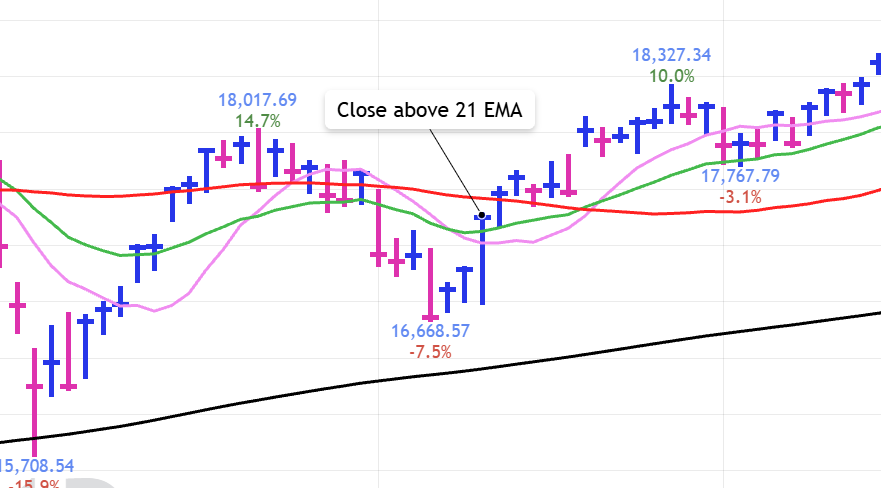
This is your first probe, a small starter position.
You have to buy something. You want to start looking for setups and get involved.
Don’t get aggressive here. One-third of your full position size.
Step 2: The low is above the 21-day
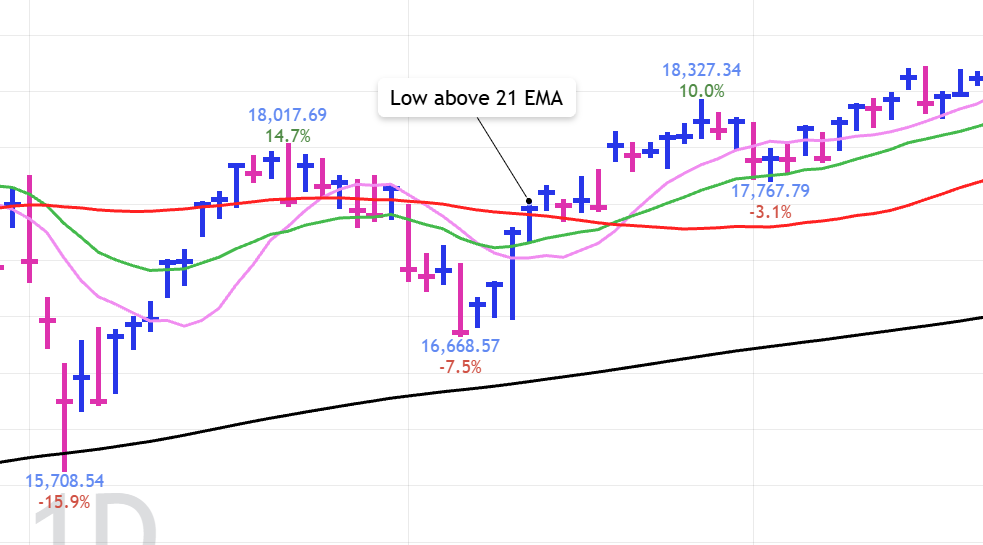
Now the whole day’s range is above the line. You are starting to treat the 21-day as support.
Take the next step. Add up to two-thirds of your full position size.
Step 3: The low stays above the 21-day for 3 days
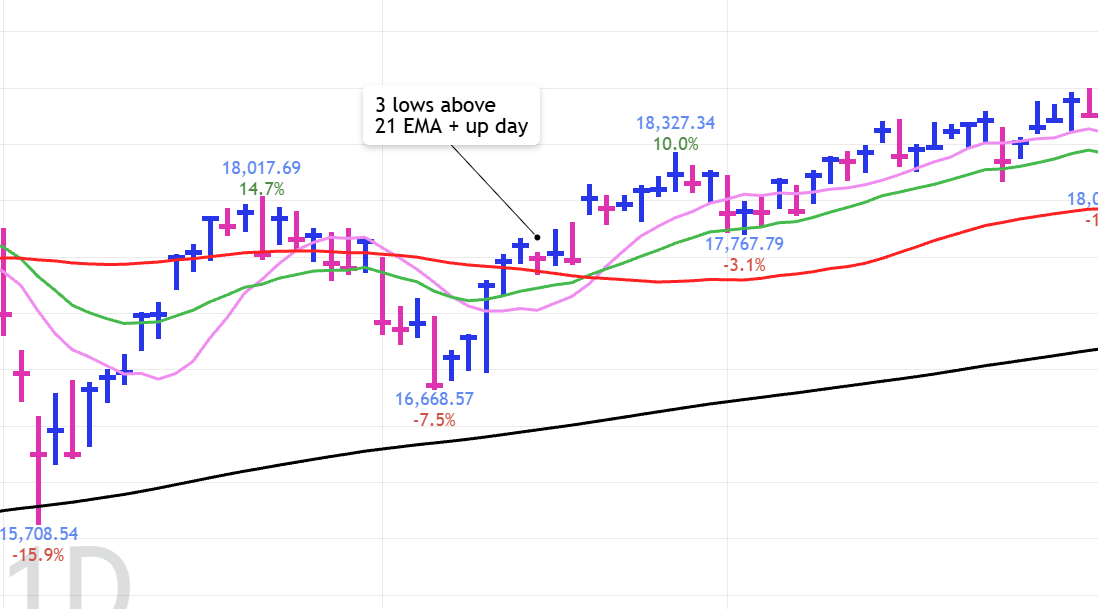
This is where you can get more aggressive.
For me, this is close to, if not at, fully invested. If the setups are there and it’s very clear.
One nuance matters here. Step 3 does not turn on until you get an up day after those 3 days.
Say you get a day above the 21, then the low above, then a gap up that closes a little lower, but the low holds. Another lower day, low still holds. It still has not started. You need the up day after.
You don’t want to trade against the market.
Think of it as a traffic light running in reverse. Red to yellow to green.
It’s not perfect
You can get chopped even with this checklist.
What it does is force you to be more patient. It makes you let the trend develop, especially in the transition.
A choppy market is the worst enemy of a momentum growth strategy.
It is worse than a downtrend. In a downtrend it’s easy for us as trend followers to stay out of the way. Chop is the worst.
You will see the market flirt with the 21-day. You get the full 3 days above, then it breaks. Then you get the full 3 days above again.
So build a kill switch. If you are getting continuously chopped up, reduce size.
Have a system for a cold streak. It is the only way I have found to reduce the damage with this style.
That is why my probes are so light this week. 2% to 3% positions, capped at 5%.
What breaks it
Same thing in reverse.
A close below the 21-day is the first warning.
A high below the 21-day is the second.
Three days below the 21-day, and you are completely out of it.
This is secondary to your stops and risk management on individual stocks. If your stocks break down first, sell those first.
If the index breaks down and your stocks aren’t giving sell signals, reduce size. Judge each stock on its own merit. If it’s acting strong, that’s a judgment call. It’s nuanced.
None of it matters without setups
This only matters if stocks are set up.
You want leading stocks with growing earnings and sales, coming out of tight consolidations after strong moves higher.
We cover the setups every week in the Sunday trading plan. Free subscribers get the market outlook. Paid subscribers get the full plan and the actionable ideas.
Trade safe. Use stops. See you next time, and reach out if you have questions.
This is not financial advice. Educational purposes only.