


There’s a guy named Stanley Druckenmiller.
If you’ve spent any time around traders, you know the name. People in the business talk about hedge fund managers the way other people talk about athletes. LeBron, Jordan, Brady. There’s a tier of names that everyone in markets agrees on, and Druck is at the top of it. Thirty percent annualized returns over thirty years. Never had a down year. The kind of track record that doesn’t make sense.
What makes him different from most of the legends is that he’s elusive. No book on Amazon. No course. If you want to learn from him, you have to dig through old interviews and piece it together yourself. The mystique adds to it.
The most famous story about him is when he broke the Bank of England. He was running Soros’s fund. He’d built a thesis that the British pound was going to crack against the Deutschmark. He’d done the work. He believed the trade was as close to a sure thing as anything in markets ever gets.
He went to Soros with the position size. Big position. The kind of size that would make most fund managers sweat.
Soros looked at him and said: what’s wrong with you? Why is it so small?
The lesson Druck took from that conversation defined his career.
When you know you’re right, you have to be right big.
That trade made Soros’s fund a billion dollars in a single day.
Here’s the tension every trader has to resolve.
Ask any successful trader what the number one rule of this game is and they’ll give you the same answer. Survival. You have to stay in the game. The math of compounding only works while you’re still playing. Time does most of the work, but you have to give time the chance to work.
Everything I learned coming up under the O’Neil system was built around survival. Cut losses fast. Keep small losses small. Trim what’s broken and add to what works. The whole framework exists to keep you alive long enough for the winners to do their thing.
So how does that reconcile with Druckenmiller saying you have to be right big? On the surface they sound opposed. One framework says protect the downside. The other says swing huge. Which one is the real rule?
I spent years wrestling with this.
The answer is that they’re sequential, not opposed.
Cut your losses fast on most trades. That’s the foundation. That’s how you stay solvent through the years when nothing is working. Small wins, small losses, manage the book, live to trade another day.
Then every so often, the market sets up a trade where everything lines up. The kind of trade where you can see it before it happens. Where the chart you’re watching matches a chart you studied at 3am. Where the market, the theme, the leader, and the precedent all point in the same direction.
That’s the trade you stomp on.
Most traders get the first half right and miss the second half entirely. They cut their losses well. They just go their whole career being technically correct and meaningfully underpaid because they size every trade the same way.
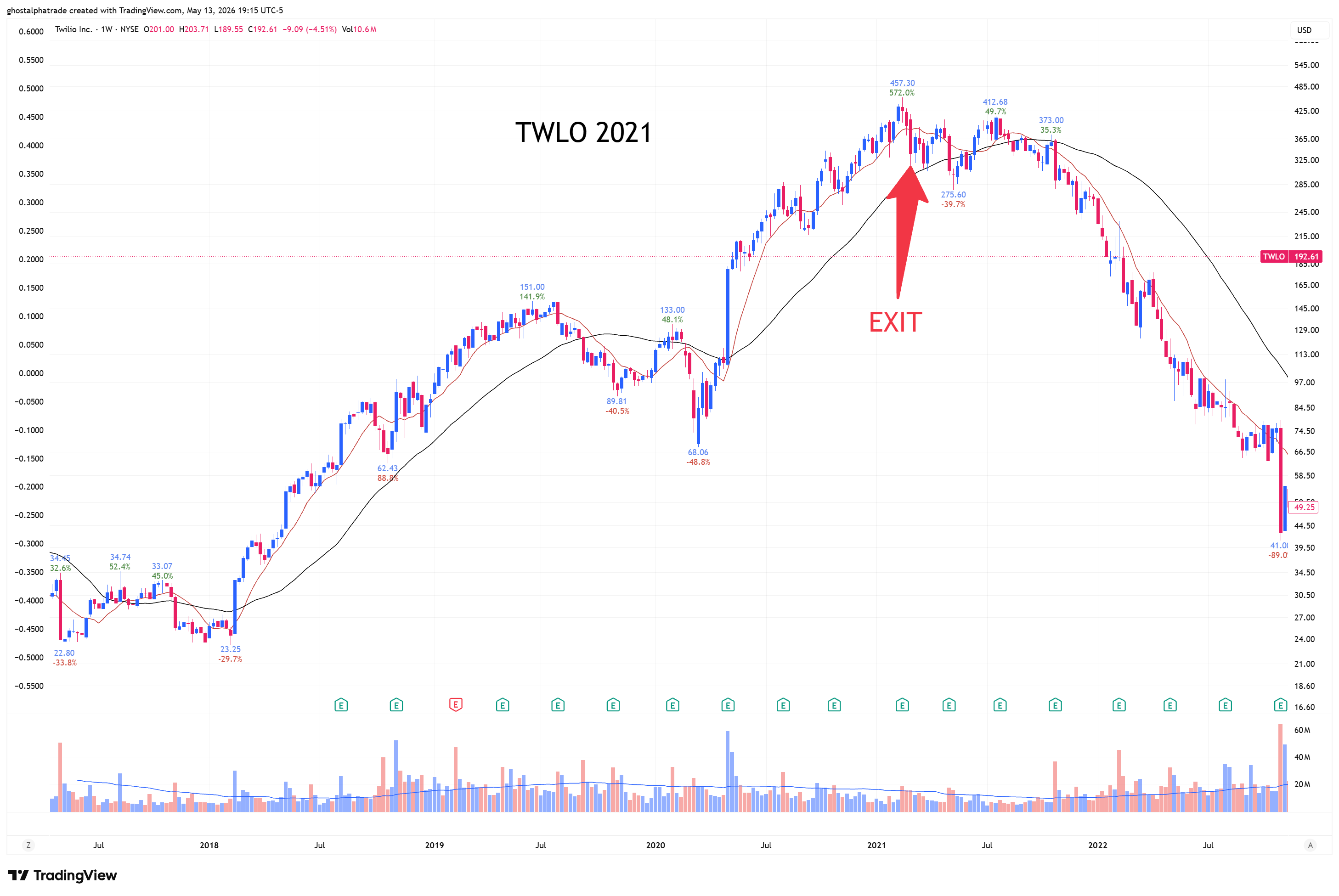
Before I tell you the framework, let me tell you about a stock called Twilio.
This was 2020 to 2021. I was working at Twilio at the time, and like most employees at growth companies, I’d been accumulating company stock through the ESPP. You buy and hold a piece of the company you work for. Standard stuff.
My original grant on accepting the offer was around ten thousand dollars worth of stock. By the peak of that move, it was worth eighty. The business was firing on all cylinders. Everyone in the company was watching the price.
Then Twilio broke its 50-day moving average.
I sold every share.
A coworker found out and asked me what I was doing. We were killing it. Why would I sell?
I told him I had a rule. I don’t own stocks below their 50-day moving average. The company can be great. The chart is something else. The chart was broken, so I was out.
He thought I was nuts. I loved Twilio. I still love Twilio. It’s a great business and I’m grateful for everything that job did for my career. The business was one thing. The stock was a chart, and the chart had told me to leave.
That sale turned out to be the top.
Twilio went on to a years-long downtrend. The eighty thousand would have become twenty, then less. The rule saved me from giving it all back. The rule worked even when I didn’t want it to. The rule worked even when it cost me a story about riding my company stock to the moon.
That’s the example I come back to in my own head every time I’m tempted to break a rule. Rules work because rules work. That’s why you have them.
That’s the survival half of the equation. Now let’s talk about the other half.
The Stars Aligned framework.
The whole point is to give you a checklist for when it’s appropriate to bet big. Not a feeling. Not a hunch. A specific, comprehensive checklist that has to be fully met before you size up.
If even one item is missing, the trade can still be a great trade. It just gets sized like a normal A-grade setup. The “stomp on it” sizing is reserved for when the full checklist clears.
Four items.
1. A leading stock you’re already up on. At least ten percent, ideally fifteen. This is two things in one. The stock has to be a proven leader, a name that has already led in a previous leg of this bull market, established itself as a top relative strength name, and is now setting up for the next leg. And you have to be up on it. You’re playing with house money. You’re taking a bigger swing with profit, not principal. Soros said it himself in his interview with Charlie Rose. The asymmetry of pressing into a stock where you have a cushion is completely different from initiating a concentrated position fresh.
This is the one most traders get backwards. They see a fresh breakout, feel the conviction, and stomp on it. Then they get shaken out on the first normal pullback because they have no room to be wrong. The fix is patience. The first breakout in a name isn’t where you bet your year. The first breakout is what gives you the cushion so you can bet your year on the second or third base.
2. Market in a power trend. The general backdrop has to be healthy. Indexes above their key moving averages, leaders working, the kind of tape where you can use margin without flinching. I’ll write a full post on power trends another time. If you’re not sure whether you’re in one, you’re probably not. Power trends are obvious when they’re happening.
3. Leading theme. Bull markets are thematic. Every cycle has a story. In 1999 it was the internet. In the 2010s it was cloud and software. Right now it’s AI. The leading theme is usually obvious if you look at what’s pulling the indexes higher. Your stars-aligned trade should be in that theme.
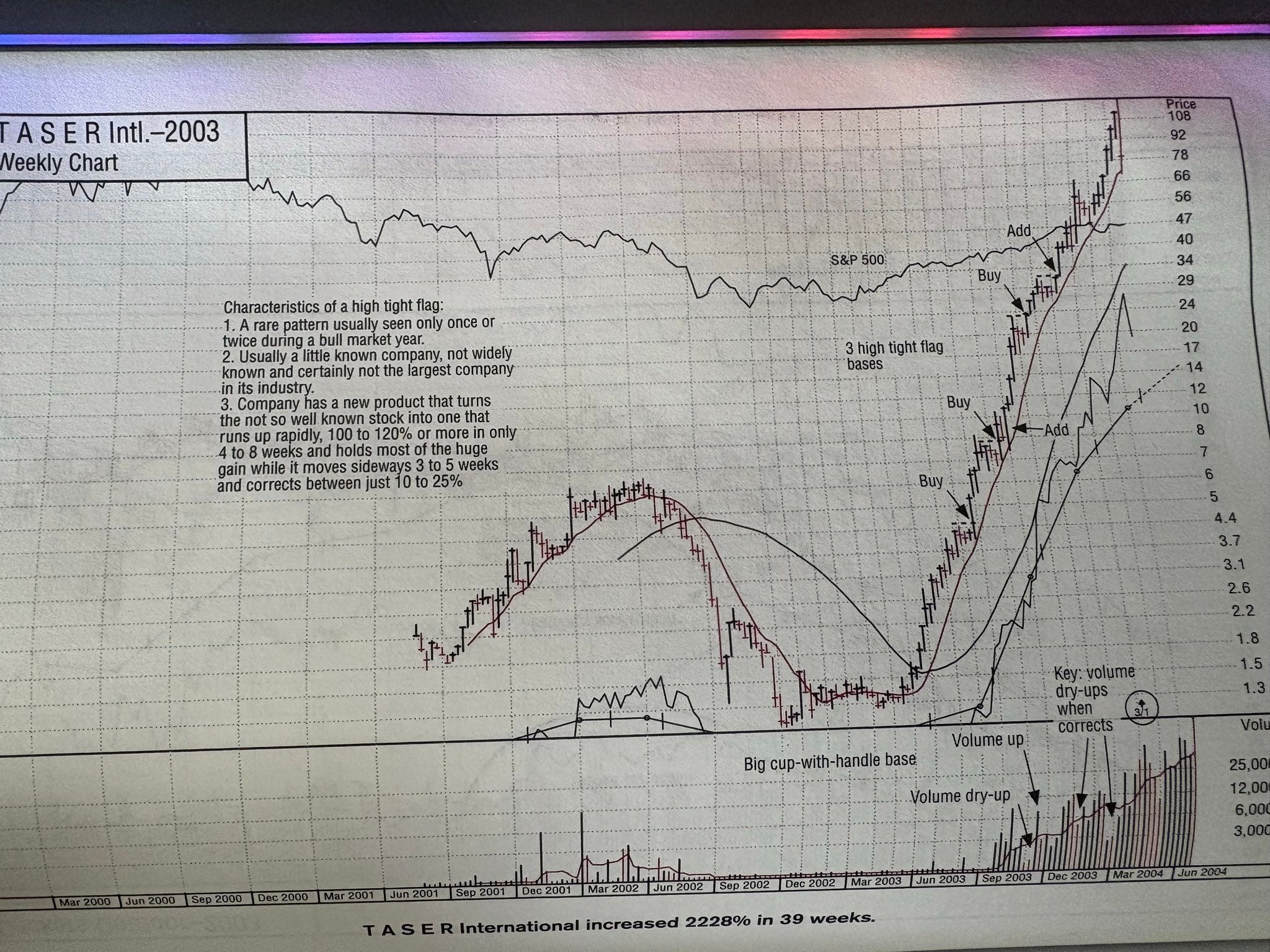
4. Historical precedent that gives you a technical thesis. You need an old chart that matches the current setup. Same shape, same behavior, same setup, same role in its cycle. When you can pull up a chart from twenty years ago and trace it over your current chart, you have a precedent.
The precedent gives you the technical thesis. It tells you what the breakout should look like, how the stock should behave in the days after, where the moving averages should sit, what the volume should do. There will be variations. The precedent gives you shades of what to expect, not a one-to-one prediction.
Here’s the part that’s hard to explain unless you’ve felt it.
When the trade starts moving, and it moves the way your precedent moved, the stock starts to feel like a magnet. Every move pulls you deeper into the conviction. The chart is doing what the precedent did, and you can almost feel the next move before it prints.
That feeling is the stars aligning. That feeling is what tells you the precedent is real and the trade is the one. You either feel it or you don’t. When you feel it, you size accordingly.
How much is “big”?
This depends entirely on you. My number is not your number.
For context, my normal max position size is twenty to twenty-five percent of total equity. On a stars-aligned trade, I’ll go to forty or forty-five percent. Roughly double my normal max. I also double my risk budget. I normally risk one percent of total equity per trade. On a stars-aligned trade, two.
William O’Neil himself used to go to two hundred percent of his account on his big bets. Margined to the gills. That’s the legend version. Most of us are wired differently. I’m not built to sit with that. Forty-five percent is the upper limit of what I can hold through volatility.
What matters is the ratio. Whatever your normal max is, a stars-aligned trade should be roughly double it. The conditions are doubly favorable, so the size gets doubled.
One thing has to be said clearly.
Having the stars align does not guarantee that the trade works. The trade can fail. It can fail spectacularly. The bigger the size, the bigger the consequence if it goes wrong.
That’s why the checklist matters. That’s why you do the work. That’s why you study the precedent until 3am. You’re earning the right to bet big by doing the homework most traders skip. The size is the reward for the work, but the work doesn’t guarantee the outcome.
The rules from the survival half of the equation still apply. The stop is still the stop. The 50-day moving average is still the line. If the precedent stops working, you cut. The size up changes the upside if you’re right. The rules stay the same.
Here’s what took me a long time to understand.
The breakout is step one of fifty.
Stars-aligned trades are position trades. The whole point is to ride them. My target hold time is six to twelve months. Sometimes longer. NVIDIA has been longer.
Once you’re in the position, the work changes. You trade around a core. Trim into strength. Add back on pullbacks to key moving averages. Defend the position when it shakes you. Sit through the wiggles. Let the precedent play out over weeks and months.
This is where most traders mess it up. They get the entry right. They size correctly. Then they take profits on the first ten percent move because holding something that size feels uncomfortable. They turn a stars-aligned setup into a regular swing trade and leave the move on the table.
If you’re going to take profits at ten percent, you didn’t need to size it up. The whole reason to do the work is to ride the move.
Bringing it back.
Druckenmiller’s lesson and the survival lesson work together. You survive on the small trades so you can be there for the big ones. You cut losses on the regular A-grade setups so the winners can compound. Then every so often, when the stars actually align, you take the shot you’ve been waiting for.
Most of your trades will be about staying in the game.
A few of your trades will change your life.
The work is figuring out which one is which.
I like the survival-first framing here because that really is the foundation. I’d also add that bigger swings are a very different conversation from building investment foundations. For a lot of people, emergency savings, debt management, retirement accounts, and risk tolerance should come first before stepping into more concentrated strategies like this.