


For years I thought the finish line was a watch.
A Rolex Datejust 41mm with the fluted bezel, the grey and green dial they call “The Wimbledon”. That was the picture in my head of what success looked like. Not a number in an account. A specific object I could put on my wrist and finally feel like I had made it.
I bought lesser watches on the way there. An Omega Speedmaster. A Tudor GMT. Good watches, but in my mind they were placeholders. Stepping stones to the real thing.
Then one day the jeweler called. He had one for me. I remember the excitement, the drive over, the feeling of finally paying for the thing I had wanted for years.
I felt accomplished for about a day.
Then I just stopped reaching for it. It was never the right occasion. In some rooms it felt like it made me look like I was trying too hard. So I kept grabbing the Tudor instead, because it was lighter, easier, more me.
At some point I started telling myself the Rolex would be something I passed down to my son. And that’s when it really hit me. My son isn’t going to want the watch I bought and left in a drawer. He’s going to want the watch he actually saw on my wrist.
The Rolex was never a dream. It was a trophy for a race I didn’t choose to run.
The trap has a name.
Psychologists call it relative deprivation. You don’t feel behind because of what you have. You feel behind because of what the people around you have. Your neighbor puts in a patio, and suddenly your perfectly good backyard needs a patio. A friend shows up in a new car, and the car you drove happily for three years starts to feel embarrassing.
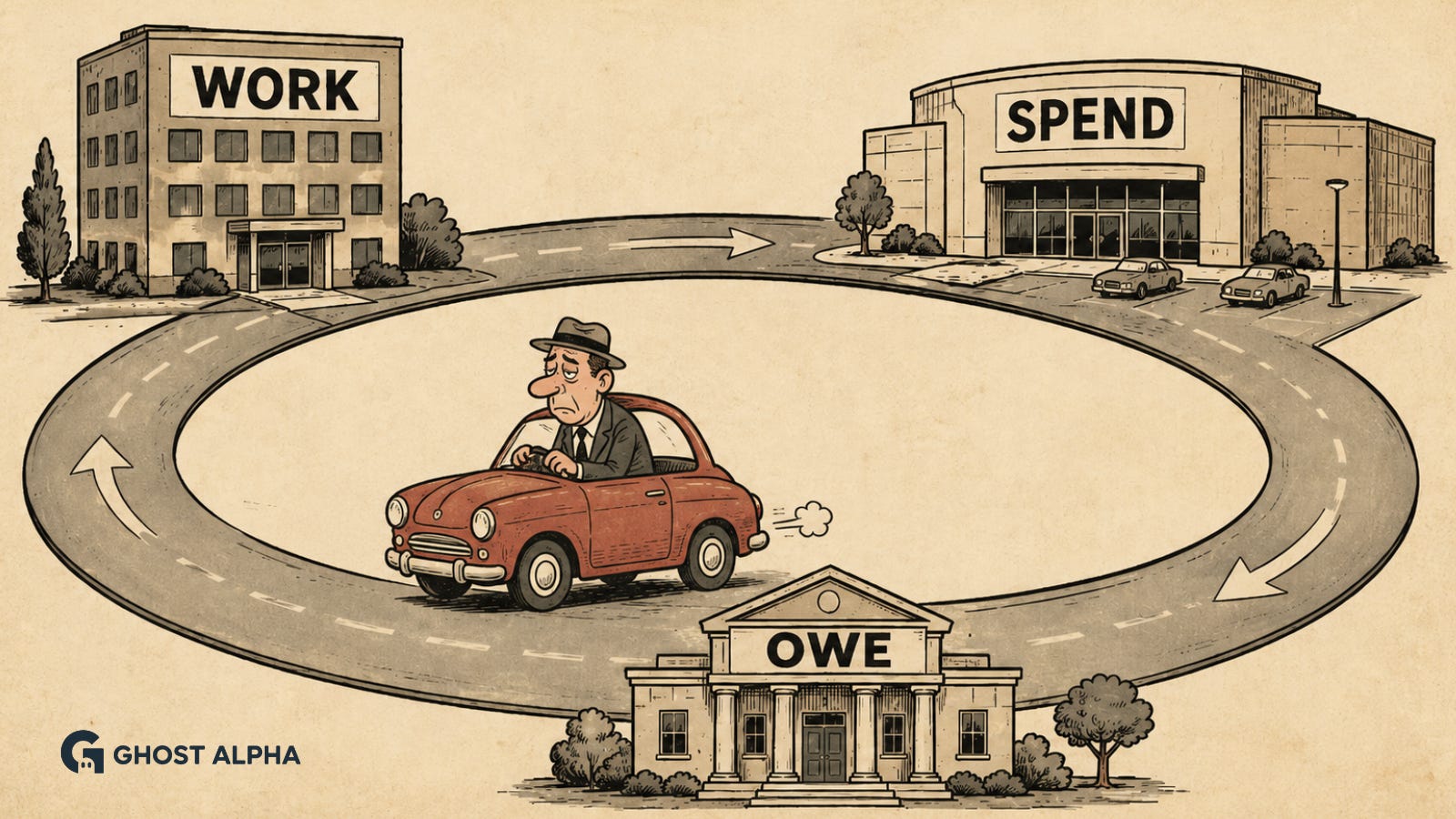
The comparison never ends, because the moment you catch up, the reference point moves. Somebody always has the nicer thing. So you take the promotion you didn’t really want, at the job that quietly bores you, to fund a life that was designed by people you’re trying to impress.
That’s the real trap. Not the job, but rather the reason you can’t leave it.
You slowly mold yourself into whatever you think the world expects. The new title, the new car, the right zip code. And every one of those choices costs a little piece of the actual you. Your independence. Your creativity. The quest you would have picked if nobody was watching.
That’s a miserable way to live. And almost nobody notices they’re doing it.
Getting free starts with subtraction.
Bill O’Neil used to boil the whole thing down to three words. Work, save, invest. Simple. So why does almost nobody pull it off?
Because a fourth word sneaks in between save and invest. Spend. Every raise gets eaten by a slightly nicer version of the life you already had, and the savings never show up.
Breaking out doesn’t start with making more. It starts with wanting less. Going back to the essentials. Getting honest that the next thing on the list, the watch, the patio, the upgrade, is not going to move your happiness at all.
My friend, Ryan, gave me a tactic to pause before a material purchase and say one sentence: “This isn’t going to make me happy.”
Most of the time it’s true, and the wanting just dissolves. What’s left is money you get to keep, and a clearer picture of what you actually want your life to be about.
That clarity is the whole point. Happiness was never in the object. It’s in getting to be your full self and chase the thing you’d chase if no one was keeping score.
Then you start. Small.
Here’s where people freeze. They decide they need a huge pile of money before they can begin, so they never begin.
That’s another trap. You don’t need a fortune to learn. You need a small stake you can afford to put at risk while you figure it out.
Say you’ve decided you can devote a thousand dollars to learning to trade. Don’t deploy all of it. Take a quarter of it, two hundred and fifty dollars, and trade that. Leave the rest tucked away where you can get to it later. Learn on that small slice, with real money, because the emotion of a live trade is the one thing paper trading can never teach you. Once you’re actually profitable on the small stake, you bring the rest in slowly, a little at a time.
And to be clear, I’m not telling anyone to quit their job and go trade. The day job is what funds the quest. There may come a day when you have the security to choose differently, but that day is earned, not rushed. Until then, the paycheck buys you the freedom to learn without fear.
After that, it’s just grind.
Nothing worth having skips this part.
With trading, the grind is studying. Looking at charts until the patterns start to jump out on their own. Building a strategy, writing your rules, learning where you’re strong and where you get into trouble. It’s spending a Saturday night building a model book of setups instead of doing something more fun. That’s not glamorous. That’s the sacrifice, and the sacrifice is the edge.
If you’re asking how to get better, the answer is almost never trade more. Trading more just gets you into trouble faster. The answer is study more. Look at more charts. Take your time. Keep iterating on your rules.
Stay consistent in the good stretches and the ugly ones.
There’s a line in Atomic Habits that every choice you make in a day is a vote for the person you’re becoming. Trading is no different. Every chart you review, every rule you honor, every loss you cut without flinching is a vote. You don’t become that person in a weekend. You build them one vote at a time.
You can just pick a different race.
That’s the whole thing. You don’t have to run the one you were handed. The car, the title, the watch, none of it was ever the assignment. You can put it down and choose your own.
Trading is one way through. If your thing is a business, or a craft you’ve spent years getting good at, the same law holds. Consistency plus volume plus enough time, and the outcome stops being a question. You’d almost have to try to fail.
By the way, anyone in the market for a Rolex? I have one for sale.
Ghost Alpha is a documentary of one trader’s journey and a plain-language education in how markets actually work. No gurus, no gatekeeping. If that’s your kind of thing, subscribe and come along.
Good writing! That real wealth isn’t about owning more, it’s about gaining the freedom to live life on your own terms.
Solid read. Chasing freedom is a lot more valuable than chasing stuff.