



TSLA, 2022.
I was heavy. Not 200% long, but well over 100%, and something close to 80 or 90 percent of my whole account sat in that one name. I had one other stock next to it.
The drawdown did not blow up my account. It blew up my confidence.
That loss was demoralizing in a way the number alone does not explain. It was a long road back. And the honest read on what happened is simple. That was me trying to be Bill O’Neil, and it not working.
I still use margin. But I have to earn it from myself first, and that is what this post is about.
The fund that got liquidated last week
By now you have probably heard of Situational Awareness.
It is the AI hedge fund started by Leopold Aschenbrenner, a former OpenAI researcher who left to build a fund around the most popular theme in the world. It had a great start. Up 439% from the beginning of 2026 through June. Assets peaked around $45 billion in early July.
Then last week it made worldwide news.
Aschenbrenner got margin called on his public positions. Bank of America, Goldman Sachs and JPMorgan were his prime brokers, and the fund had to sell the entire public book to Citadel at roughly a 10% discount. About $16 billion of stock, handed over. Assets fell to around $10 billion. He got to keep the private holdings.
The number that matters for our purposes: the fund had used as much as 400% leverage.
Nebius, SanDisk, Micron and CoreWeave were among its top disclosed positions. Each one shed more than 35% in a single month.
This is not the first time
Like most things on Wall Street, this has happened before.
There was a fund in the 90s called Long-Term Capital Management. It employed some of the best traders, economists and Nobel Prize winners you can think of. Myron Scholes and Robert Merton, who won the 1997 Nobel for the Black-Scholes model, sat on the board.
The smartest minds you can possibly think of, running sophisticated strategies with incredible returns.
Then August 1998 came and their positions turned against them. Their leverage was north of 25 to 1. Roughly $5 billion in equity controlling $125 billion in assets. They could not get out.
The fund lost $4.6 billion in under four months. The Federal Reserve had to intervene. Fourteen banks put up $3.6 billion in September of 1998 to wind the thing down in an orderly way. The Fed did not lend a dollar of its own money. It just got everyone in a room.
There is a great book on this called When Genius Failed by Roger Lowenstein. Highly recommended.
Two funds. Completely different strategies. Same recipe for disaster.
Really smart people. Highly leveraged positions.
I think being smart sometimes opens the door for stubbornness. When you have done that much analysis, admitting you are wrong gets very hard. The market does not care how much work you did. It is not forgiving for that type of individual.
A disclaimer, and I mean it:
This is not financial advice. This is a very sensitive topic. Talk to your financial advisor before you even apply for a margin account.
How I earn margin
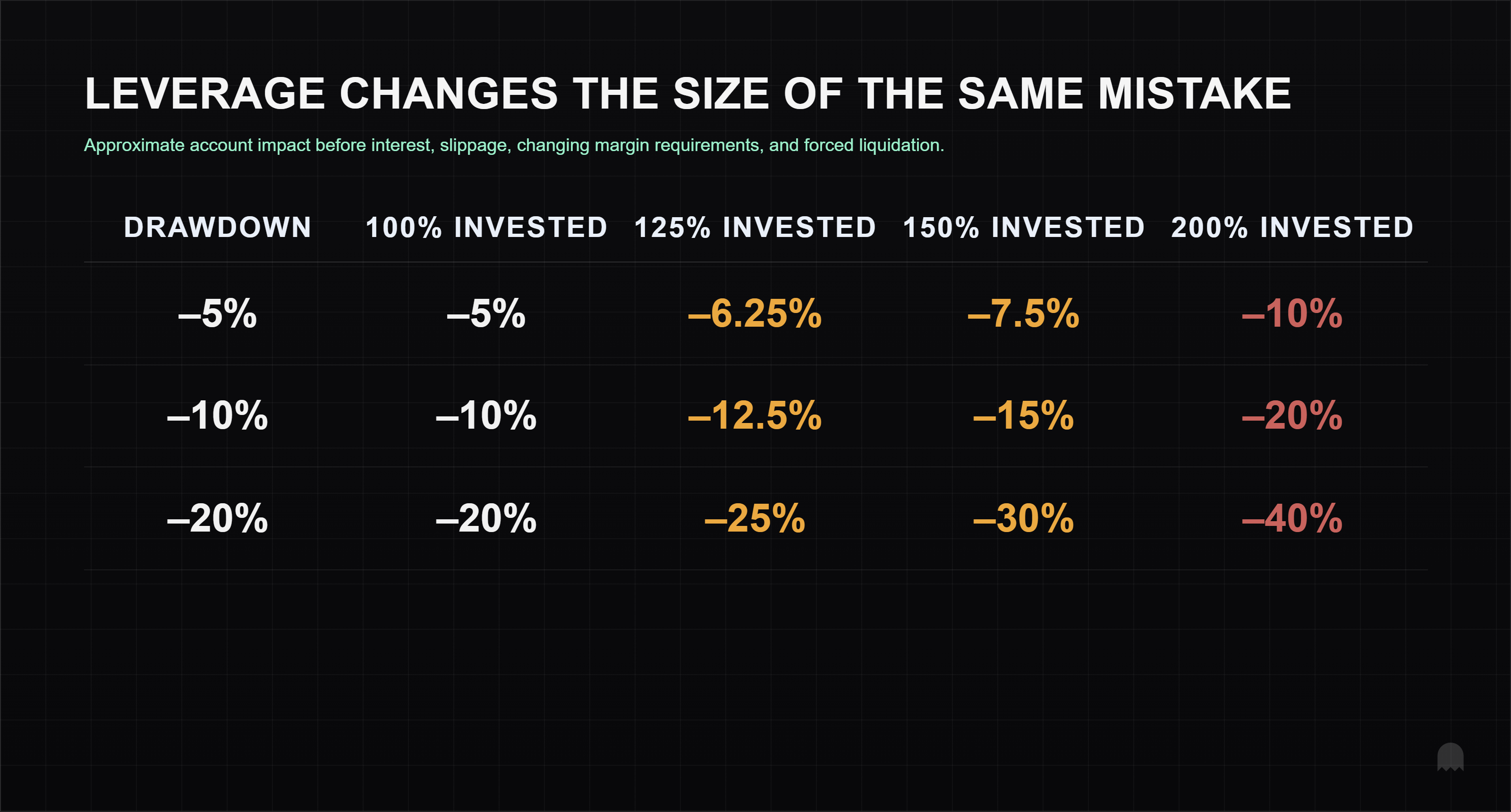
Margin does not give you an edge. It magnifies the one you have, or the one you do not have. It adds octane. Rocket fuel, really, to whatever is already happening in your account.
So the question is never “can I borrow.” It is “have I earned it.”
First, the market has to be in a confirmed uptrend.
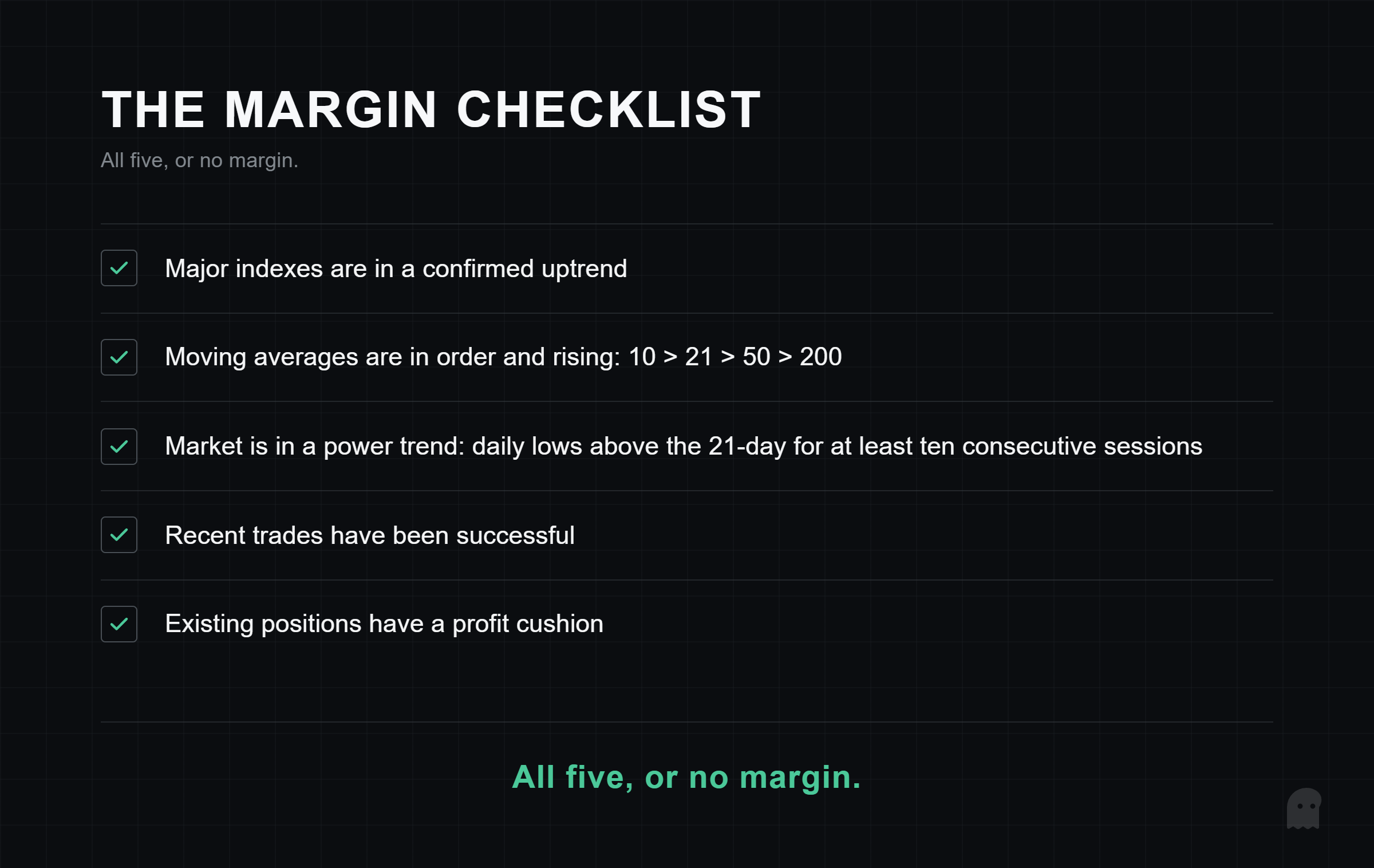
I am not going to spend a lot of time defining an uptrend here. Use whatever system tells you when to be aggressive and lean on it. For me it comes down to the key moving averages being in order. The 10-day above the 21-day, the 21 above the 50, the 50 above the 200. Rising and stacked.
If the moving averages are not in order and ascending, I do not consider margin at all.
Second, we have to be in a power trend.
Power trend is a term made popular by Mike Webster. The piece I lean on most: the daily lows of the Nasdaq, stay above the 21-day moving average for at least ten days.
Third, and this one matters more, my own trades have to be working.
The indexes can be great and you can still be out of sync with the market.
Your account gives you the best feedback you are going to get. Your most recent trades are the real read on how well you are trading and how in sync you are with what is in front of you.
Fourth, existing positions need a profit cushion.
Profit cushion means open gains you can afford to give back. I call it seeing a lot of green. It is what it sounds like. You open your brokerage account and everything is up.
A strong confirmed power trend, and your own trades doing really well inside it. That is when I find it advantageous to push the gas.
Do not use margin to get concentrated in one name
I remember William O’Neil being famous for going 200% long in a single name. Trying to replicate that has cost me a ton of money. See the top of this post.
My full position is 20% of my account. If it runs, I trim back to 20%. If it keeps working I will let it grow into 25 or 30, and 25 to 30 is my ceiling. That is very concentrated for most people. I have heard 40 and I think 40 is too nuts.
So when I go on margin, it is not because one name got bigger. It is because other A+ setups showed up.
Here is what that actually looks like. Say there are two names with really strong upside reversals. Two of those, in a good market, while I am up. I will take both. That is an extra 40% of exposure across two names, on borrowed money.
Sometimes I will not even add a single stock. If the market looks strong but I am comfortable with what I already own in the leaders, I will just add index exposure. SPY or QQQ.
The point is you are adding different instruments. You are not going 150% into one name.
Sell down to the sleeping point
There is a famous saying, sell down to the sleeping point. I always thought that was anecdotal and a little silly. There is no system in it.
It is also completely true.
Marvell and Bloom Energy, in the middle of their runs. The positions had grown a little beyond my control. I could barely sleep. I had put so much into those trades and I knew I needed to reduce.
It is embarrassing to write that while I am preaching on being responsible. I still make these mistakes sometimes. It gets away from me and I try to rectify it.
If you are waking up at three in the morning to check the futures, you are too heavy. I have been there. Trust me, I have been there.
And if you are reading a piece about margin while trading growth stocks, you will be there at some point.
The risk of being too concentrated is not only blowing up your account. It is getting shaken out of a normal, natural pullback. I trade better when I can sit in a leader for a longer period of time, and I can only do that when the position is small enough to let me sit.
Find the position size that lets you sit.
The part margin cannot protect you from
I was on margin almost the entire month of April and most of May.
Then the AI trade got hit in June. I lost 11% of my total account in a single day. I was sick, in California, and I woke up to SanDisk down big.
There is always gap down risk. You cannot control that. Your stop does not execute on a gap.
You read what the market is doing and you go along with it. Sometimes the current is moving fast and in the right direction, and refusing to take any advantage of that is its own mistake if you are trying to grow a smaller account.
It is a double edged sword either way.
The checklist
Here is the one I run. I strongly recommend you build your own version, but this is mine:
The absolute no-gos
I usually do not talk in absolutes. These are absolutes.
Never use margin to average down.
Never use margin to recover.
Never use margin on a revenge trade.
Never go into an earnings report at a reckless size because margin let you.
Be careful out there
For a smaller account, margin can be a great asset. It can also be your worst enemy. Same tool, and the difference is you.
Use it in a strong market with the wind at your back, while you are already winning. Stay away from it on the losing streak.
Treat the market like a casino and it will treat you like a gambler. Treat it like a business and it will pay you like a business.
Operate as if you have to report your trades to a boss and every one of them has to be defendable. Run your own checklist before you do anything reckless.
Look out for the next trading plan this weekend. Happy trading.
Three lines for Notes
Margin does not give you an edge. It magnifies the one you have, or the one you don’t.
If you are waking up at 3am to check the futures, you are too heavy.
Treat the market like a casino and it will treat you like a gambler. Treat it like a business and it will pay you like a business.
Waking up at 3 a.m. to check futures is probably as good a warning sign as any. I like that way of looking at risk.
To be fully honest, margin is probably the only reason why my personal growth has been so good in comparison to me previously never using it. I often deploy most of the capital in the account, and use margin to buy out options to hedge against the existing trades. I look at it as opportunity rather than borrowing to risk more. I think everyone should learn to use margin and learn to hedge and protect their trades, whether it’s through trading the Beta or the Delta of their positions 🔥