



The walk back from lunch felt different that day.
It was 2018, and Tilray had just put up the biggest dollar day of my trading life. Real money. The kind of number where you start doing the math on your apartment lease and your car payment and how long you could go without a paycheck.
I remember thinking, very clearly, I don’t need this job.
I didn’t quit. But for about 72 hours, I walked around like a guy who was about to.
Then came the next trade.
It was a Chinese ADR. I won’t pretend I remember the ticker. What I remember is the setup looked like it had octane, and I sized into it like a guy who had just figured the market out. Bigger than I should have. Earlier than I should have. With less of a plan than I should have, because plans are for people who haven’t just had their biggest dollar day.
It went against me almost immediately.
And I remember the cold. That’s the only word for it. A cold feeling in your stomach that has nothing to do with the money and everything to do with the realization that the version of you who walked back from lunch a few days earlier was not, in fact, a genius. He was a guy who got one right and immediately tried to cash the lottery ticket twice.
It was, functionally, a gambling loss. I don’t gamble. I tell myself I don’t gamble. But that trade was a bet, and I knew it the moment I clicked the button.
Your worst trade almost always comes right after your best one.
That’s the pattern. It’s not bad luck. It’s not some cosmic karma rebalancing your account. It’s a math problem dressed up as an emotional one. When you have a big winner, your sense of what’s normal recalibrates upward. The next setup that walks through the door doesn’t have to actually be better. It just has to look good enough for the new, inflated version of you to oversize into it.
And oversizing is the thing. Not the entry. Not the thesis. The size.
Mike Webster taught me something I didn’t fully understand at the time.
In the late 90s, his account ran up something like 1,600 percent. Real number. He was a serious trader at a serious firm, and that’s what he did. Years later he went back and stress-tested the QCOM trade, that legendary 1999 run where the stock went up something on the order of 2,000 percent.
Some of the guys at the firm went all in. Margin. Concentration. Two hundred percent loaded in a single name. The kind of position that makes a career.
And they finished the year up around 500 percent.
Five hundred percent is a great year. Five hundred percent on a stock that did 2,000 is a tragedy.
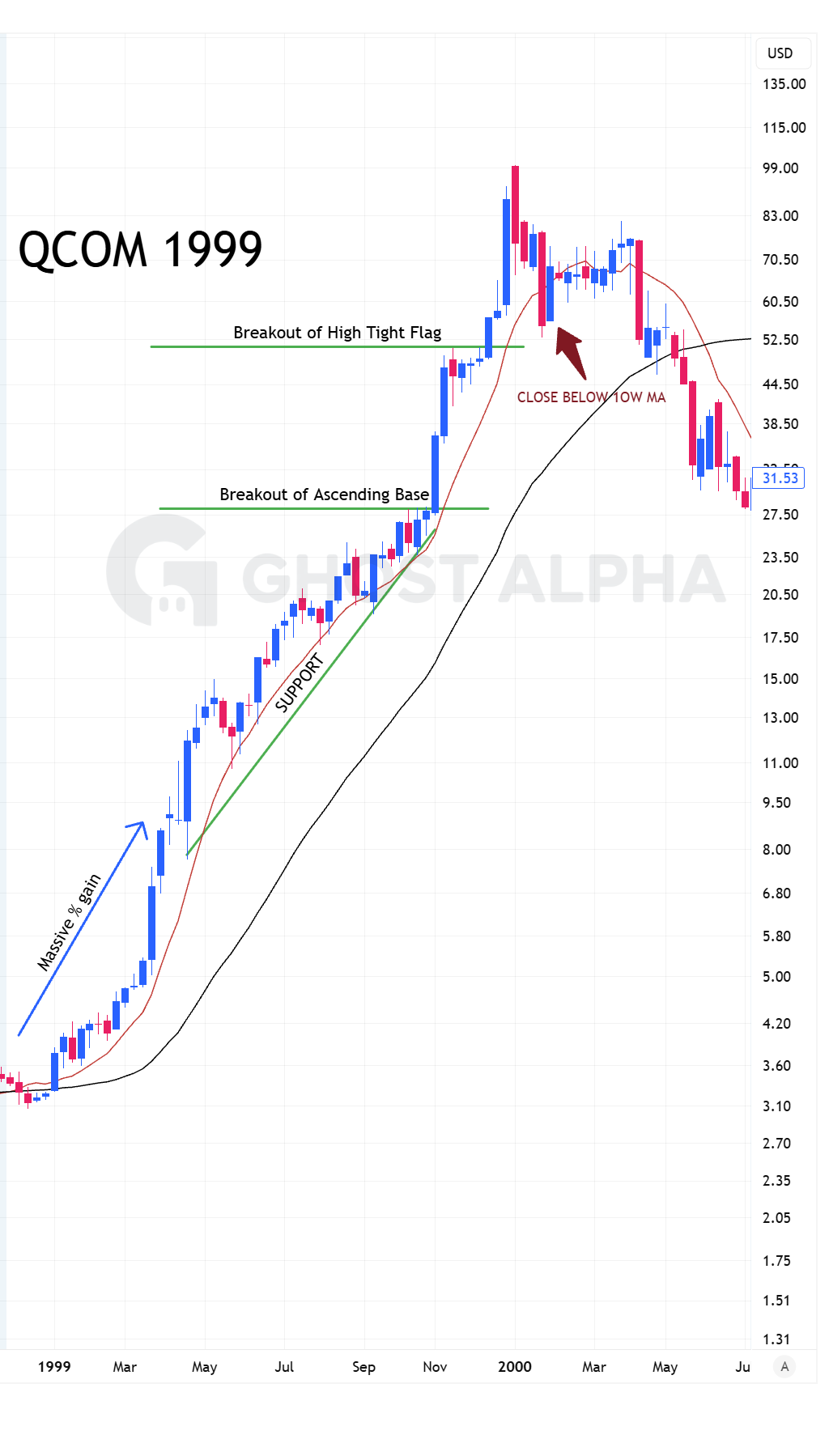
The reason isn’t a mystery. When you’re 200 percent in one name, you have no room. Every wiggle is a heart attack. Every drawdown is a margin call waiting to happen. You can’t hold. You can’t breathe. You’re not riding the move, you’re hostage to it. So you cut on the first real shake, and you spend the rest of the year trying to climb back into a position that has already left without you.
The backtest Webster ran was the part that broke my brain. If those same traders had used a controlled core position, capping out somewhere in the 25 to 30 percent range, and just let time do the work, they would have multiplied their returns.
Smaller size. Same stock. More money. Because they had the room to actually hold it.
That goes against everything we’re conditioned to believe.
We’re trading like dopamine addicts now. Everything is instant. Your brokerage app has confetti animations. Your portfolio updates by the second. Your X feed is full of guys posting screenshots of one good trade and acting like they cracked the code.
Time is the variable nobody respects. And time is the great equalizer.
Warren Buffett doesn’t use margin. He doesn’t use leverage in any meaningful way. He uses time. That’s the whole edge. He bought what he bought, sized it where he sized it, and let the years do the math. We look at his returns and think the secret is the stock picking. The secret is the holding.
This is where I am right now in my own development.
What I’m working on this year, and what I’m trying to actually demonstrate in real time on the Substack, is becoming a position trader. Not a swing trader who got lucky and held for a few extra weeks. A real position trader. Someone who can sit with a core in a true market leader for 12 to 18 months and look back at the chart and say, calmly, that he aced the test.
The proof of concept I have is NVIDIA in my IRA. I sized it, I sat with it, and I let it work. The reason that one worked wasn’t because I’m smarter in my IRA. It’s because the structure of the account forced me to be patient. No itchy trigger finger. No screen-watching. Just time.
This week I’ve been studying the QCOM chart from 1999, pulling up the weekly, walking through how that move actually unfolded, where the bases formed, where the shake-outs were, what it would have taken to hold through them. It’s homework. The lesson is the same lesson Webster pulled out of it: the guys who held smaller and gave it room ended up with the trade. The guys who maxed in got chopped out of their own thesis.
The live application is SNDK. I’m in it. It’s where I’m trying to actually run the playbook. Smaller starter, real plan, real levels, real space to be wrong for a minute without panicking. A core position I can live with through a 10 percent shake, and a max position I have to actually earn into.
It’s a less exciting way to trade. It’s also, by every piece of evidence I’ve ever seen, the way that actually compounds.
The afterglow is the danger zone.
If you’re reading this and you’ve just had a big winner, congratulations, genuinely. Now watch yourself. The next trade you take is the one that’s going to test whether the win was a result of your process or a result of you getting one right. The market does not reward you for being a genius last week. It rewards you for being disciplined this week.
Plan your trade. Trade your plan. Size like you might be wrong, because sometimes you will be.
And when you’re not, when you actually catch a leader and the chart starts working, give the trade the one thing nobody wants to give it.
Time.
Ghost Alpha is a documentary of one trader’s CAN SLIM journey. If this hit, the best thing you can do is hit subscribe and stick around. The good stuff compounds.