


It’s easy to get conditioned with everything at our fingertips. Impulse buys get easy. We’re conditioned as consumers to do that. I know my wife is. She does that plenty with Amazon. There’s always an Amazon box.
In all seriousness, it’s a tale of where we are right now. Everything is accessible. AI and mobile make doing what you want easier than ever. Typically that’s great. In trading it hurts you more than it helps you.
It’s great that we have access to our platforms 24/7. There’s nothing in the way of us making mistakes or not sticking to our rules.
If you’ve ever read Atomic Habits by James Clear, you really want to control your environment. Make the good habits easy to do and the bad habits hard to do. For me a lot of the time that’s overtrading.
Weekend plan, midweek trade
It happens to me frequently. I’ll spend the weekend putting up the trading plan, looking at my trades, doing my screening, and planning out my entries. That’s the best way for me to trade. It’s the way I perform the best.
Then something shows up during the week that wasn’t on my radar. Maybe it’s my best setup. Maybe I just can’t pass it up. And I take the trade.
I haven’t run the data. I bet most of those trades don’t work out for me. If I aggregated them, I don’t think those are winning trades.
The operating system
I was reading Market Wizards and Lance Breitstein has a really interesting take. My trading has gotten very systematized. I have what I call a trading operating system.
I have a trading log. I log the trades and the setups. I’m tight with my average cost. I have a trade tracker. I have a way to track the indices and a weekly read so I know where we are from a general market perspective. I have a trade diary so I can gather my thoughts.
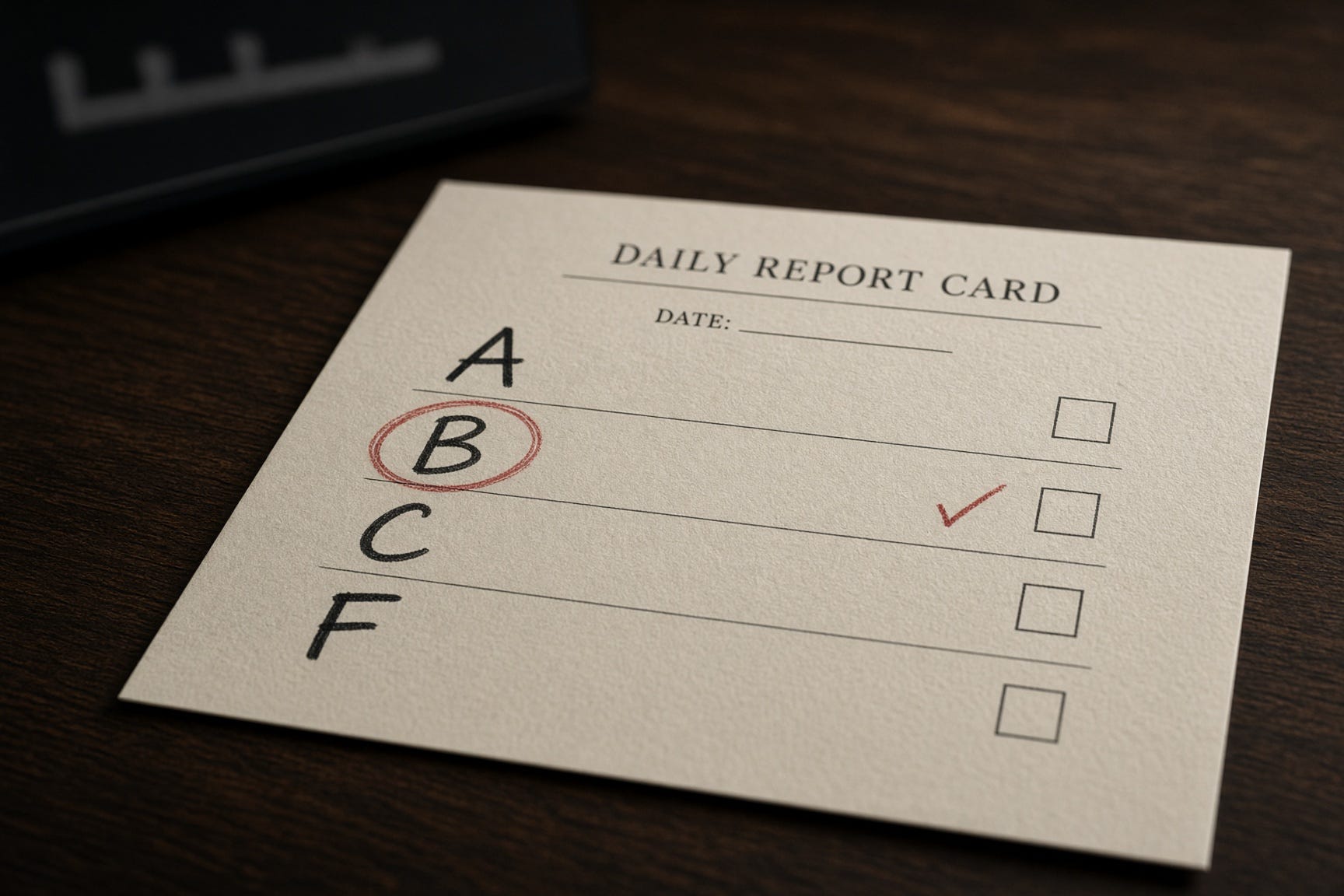
Now I’ve incorporated what I picked up from Lance. The Daily Report Card.
Going back to Atomic Habits, a tracker helps you maintain good habits. This was a perfect fit. I’ve been using it recently and I’ve seen a difference.
A through F

I give myself a grade every day.
A: Every trade is planned and I didn’t break any of my rules. 2 for 2. That’s an A.
B: I followed my rules but I did something that wasn’t in my plan. That’s a B day. That’s what I had today.
C: I did something out of my plan and I broke my rules on a particular trade.
F: I did something out of my plan and I broke the rules more than once. That’s a terrible day. That’s a compounding way to a drawdown.
You have to be honest with yourself. The important thing is being disciplined enough to do the report card. Here’s an example of an entry:

You have to be your own manager. There’s no boss in trading. Take off the trader hat. Put on the manager hat. Look at yourself objectively, almost like an out-of-body experience. Weird way to put it, but you have to be outside yourself for a second and be critical of yourself. Intellectually honest.
That’s the number one thing. Being honest with the day.
If you have your trading plan written and posted, like I do on Substack, it’s easy. Is it in the trading plan? If it isn’t, you already know whether the day is an A, B, C, or F.
If the alert didn’t go off, it wasn’t the plan
What I’ve done to keep myself from breaking the rules is simple. Screening and the plan get set every night. It’s okay if you find a new opportunity during the week. That’s fine. At least the day before, set the alert.
I think if you implement that, it’ll do wonders for your trading.
If you need help with a trading plan and you want to get started, subscribe. I’ll have one every week.
I'll start grading myself each day. Simple way to keep yourself honest and see where you’re getting off track. Thank you!
I don’t know much about stocks and I’m not 100 percent sure if I’ll invest into them in the future. But this system makes them sound much less daunting and more like any other financial tool people use in their day to day.